
At the 2022 Stuttgart WTA tournament, a 20-year-old qualifier ranked 342nd in the world walked onto court and beat Viktoria Golubic — ranked 38th at the time — in the first round. Nobody in the press box was paying much attention. They should have been. That qualifier was Eva Lys, and that result set a template she has been repeating ever since: show up as the underdog, leave with the upset.
Four years on, Eva Lys has a Lacoste sponsorship, a career-high ranking of World No. 39, and a backstory that gets more interesting the further back you go. This profile draws on her WTA official player page, her Wikipedia career record, and publicly documented match results to give you the most accurate picture available heading into the 2026 clay season.

Who Is Eva Lys? The Background Behind the Ranking
Eva Lys is a Ukrainian-born German professional tennis player, born on 12 January 2002 in Kyiv, Ukraine. Her family relocated to Hamburg when she was two years old, and Germany has been home ever since. She reached a career-high singles ranking of World No. 39 on 5 January 2026, according to the WTA’s official ranking records. As of 13 April 2026, her ranking sits at No. 78 — a drop explained by the WTA’s 52-week rolling points system, not by any sudden loss of form.
Her father, Vladimir Lys, is a former professional tennis player who represented Ukraine in the Davis Cup. He coaches her to this day from Hamburg. Her mother Maria is a lawyer. Her older sister, Lisa Matviyenko, is a competitive tennis player; she also has a younger sister, Isabella. The family dynamic is relevant to her career in a way that goes beyond biography: growing up inside a professional tennis household, with a father who competed at national team level, shaped both her technical foundation and her understanding of what long-term athletic careers actually look like.
She attended the Sportgymnasium Alter Teichweg in Hamburg and completed her Abitur — Germany’s highest secondary school qualification — with biology as her favourite subject. She speaks Russian, Ukrainian, German, and English fluently. That multilingual profile matters commercially, as we’ll get to, but it also reflects a genuinely cross-cultural identity that makes her a slightly unusual figure on the WTA Tour: technically German, emotionally connected to Ukraine, trained in a system that is neither.
One biographical detail that reframes everything else about how she competes: Lys lives with spondylarthritis, a chronic rheumatic autoimmune disease affecting the spine and joints. This is documented in her WTA player profile and has been discussed publicly in the context of how she structures her season. It is not a peripheral footnote. It is central to understanding her career arc, her tournament selection, and the way her ranking moves through the year.
Eva Lys’s career-high of World No. 39 (5 January 2026, per WTA official records) makes her one of the highest-ranked German women’s tennis players currently active on tour.
Eva Lys and Spondylarthritis: What Managing a Chronic Condition Actually Costs
Spondylarthritis is not a condition you manage once and move on from. It is a chronic inflammatory disease causing recurring pain and stiffness — primarily in the spine and large joints — whose effects are unpredictable in both timing and severity. The WTA’s official player biography for Eva Lys states directly that she manages her schedule around its effects. That sentence, buried in a player profile, carries more strategic weight than it might initially seem.
For a professional tennis player competing on a global tour, this means the calendar looks fundamentally different than it does for most of her peers. Recovery windows are not optional — they are built into the schedule as structural requirements. Some tournaments cannot be prioritised because the physical cost of travelling, competing, and recovering within a compressed window outweighs the ranking benefit of the result. Her father Vladimir, who has professional playing experience himself, is better positioned than most coaches to understand that trade-off in practical terms.
The career prize money total of US $2,250,967 — listed on her Wikipedia career record, cross-referenced against WTA tournament result data — was accumulated on a more selective schedule than most players at her ranking level maintain. That figure, read alongside her tournament count per season, tells a story of concentrated performance rather than volume. She enters fewer events and tends to go further in them.
When reading Eva Lys’s seasonal statistics, a lower match count should not be read as lack of ambition. It reflects a medically informed scheduling strategy that has produced consistent upward ranking movement across four consecutive seasons. (Related: Orioles Trade Shakeup: Christian Encarnacion-Strand Deal Analysis)
There is also a psychological dimension here that deserves plain acknowledgement. Competing at the top level of professional tennis while managing a chronic pain condition requires a different kind of mental resilience than simply grinding through fatigue. You are not just preparing for the match — you are managing a variable that your opponent does not have to account for. That Lys has produced her best tennis during a period in which her condition has been publicly known, rather than hidden, says something about how she has integrated it into her competitive identity rather than treating it as something to overcome.
Eva Lys Career Progression: What the Numbers Actually Show
Laid out chronologically, Eva Lys’s ranking trajectory shows steady, year-on-year improvement without the sharp spikes and collapses that characterise many young players who break through early. Each season has added something specific — a surface, a ranking tier, a category of opponent she can now reliably beat.
 美國即時熱搜
 美國即時熱搜
 美國即時熱搜
 美國即時熱搜
 美國即時熱搜
| Year | Key On-Court Achievement | Ranking Milestone |
|---|---|---|
| 2022 | WTA main draw debut at Stuttgart; defeated No. 38 Viktoria Golubic as a qualifier ranked No. 342 | Outside top 300 at season start |
| 2023 | First career SF at Cluj-Napoca; Grand Slam main draw debut at Australian Open; 2R at US Open as a qualifier | Broke into the top 150 range by year-end |
| 2024 | SF at Budapest and Monastir; QF at Osaka and Hamburg | Career high No. 105 (September 2024) |
| 2025 | QF at Beijing WTA 1000; first career top-10 win (over Rybakina); 4R at Australian Open as lucky loser | Finished season at No. 40 (WTA year-end ranking) |
| 2026 | Peak ranking achieved in January; clay season now underway | No. 39 (5 January 2026); No. 78 (13 April 2026) |
A note on the ranking figures: the table shows a year-end 2025 ranking of No. 40 and a January 2026 peak of No. 39. These are not contradictory. Year-end rankings are calculated at a fixed point in December, before the Australian Open swing adds or adjusts points. The January peak reflects points accumulated after the 2025 Australian Open result fed into the 52-week window. The WTA’s rolling system means a player can reach their career high several weeks after the season technically ends.
The 2022 Stuttgart result deserves more attention than it typically gets in retrospective write-ups. Qualifying for a WTA main draw as a player ranked 342nd requires winning multiple qualifying rounds against players who are themselves trying to reach the main draw. Then beating a top-40 player in the first round of the main event — that is not a fluke. That is a player performing well above her seeding in conditions designed to expose the gap between her ranking and her opponents’.
Reaching the fourth round of the Australian Open as a lucky loser — as Eva Lys did in 2025 — requires winning three consecutive main draw matches against players who all qualified directly. Lucky losers enter only when a main draw player withdraws; they do not receive a seeding or protected draw position. Three wins from that starting point remains her best Grand Slam result to date.
The 2025 Beijing win over Elena Rybakina is confirmed by the WTA as Eva Lys’s first career victory over a top-10 ranked player. Rybakina, the 2022 Wimbledon champion, is one of the most powerful servers on tour and relies on flat, heavy groundstrokes — the exact game style that can overwhelm players who depend on early ball-striking and redirected pace. Beating Rybakina is not the same as beating a top-10 player who plays into your strengths. It is a result that required Lys to solve a specific tactical problem against a player built to neutralise her game.
How Eva Lys Actually Plays: A Reading of Her Technical Game
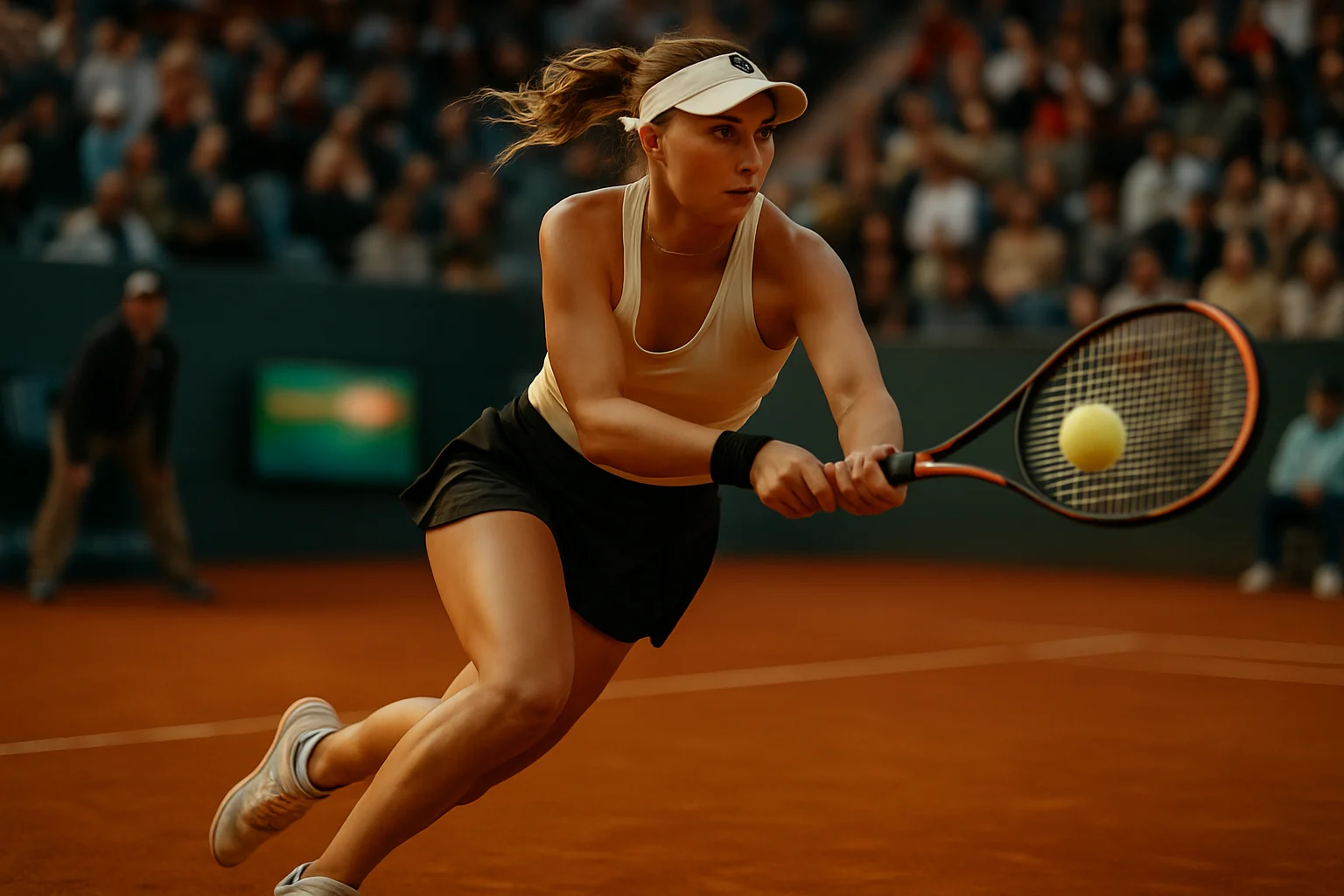
Eva Lys is not a baseline slugger in the Aryna Sabalenka mould. Her game is built on compressing time — taking the ball early, before her opponent has fully recovered position, and redirecting pace with flat, well-placed groundstrokes rather than generating her own power from the baseline. The WTA’s official player biography lists her self-described strengths as “playing to her own rhythm, taking the ball early, and fighting spirit.” That self-assessment is accurate in a way player-provided descriptions often are not.
She plays right-handed with a two-handed backhand. Her serve is not a primary weapon in terms of raw pace, but its placement and consistency reduce double-fault pressure in crucial moments — a quality that is genuinely underrated at tour level, where a single double fault at 5-6 in a third set can define a season’s ranking trajectory. On faster surfaces, the early ball-striking creates genuine problems for opponents who rely on heavy topspin and high-bouncing groundstrokes, because the ball simply does not sit up long enough for them to load properly.
- Hard courts: Strongest surface; early ball-striking is most disruptive on low, fast bounces that prevent opponents from loading their groundstrokes
- Clay courts: More challenging; slower pace gives opponents additional time to reset against her flat striking, reducing the disruption effect
- Grass courts: Low bounce suits her contact point; has navigated Wimbledon qualifying successfully and reached 2R at Wimbledon in 2025
- Best Grand Slam result: Fourth round, 2025 Australian Open (as a lucky loser)
- Career singles record: 179–121 (per Wikipedia, as of April 2026, cross-referenced against WTA results data)
The 179–121 career record, a winning percentage of approximately 60%, is consistent with a player who competes effectively at her ranking level rather than padding results against significantly weaker opposition. For context, a 60% win rate across a career spanning ITF, WTA qualifying, and WTA main draw matches — across all surfaces — is a solid baseline for a player who has spent most of her career competing up against her ranking rather than down.
Eva Lys’s current ranking of No. 78 (April 2026) reflects the WTA’s rolling 52-week points window cycling out her strong late-2025 results, not a drop in form. Her actual match results heading into the clay season should be weighted more heavily than the headline ranking movement when assessing her current competitive level.
Eva Lys and the Lacoste Partnership
Lacoste’s announcement welcoming Eva Lys as a new tennis athlete and brand ambassador — confirmed on her official Instagram account — puts her in company with a brand that has historically been selective about its tennis partnerships. Lacoste’s tennis roster has included players like Novak Djokovic and Daniil Medvedev at various points, and the brand’s positioning in the sport is built around longevity and identity rather than purely chasing the current world number one. (Related: Cubs vs Phillies: 2026 Season Showdown & Complete Analysis)
What Lacoste said in their announcement, as posted on her Instagram, was that they were welcoming her as “our new tennis athlete and creator of her own” story. That phrasing — creator of her own story — is brand language, but it points at something real. Lys’s backstory has genuine texture: born in Kyiv, raised in Hamburg, coached by her father, managing a chronic autoimmune condition, competing in multiple languages across a genuinely cross-cultural identity. These are not manufactured brand narrative elements. They are facts about her life that happen to be commercially useful.
“Lacoste welcomes @eva.lys: our new tennis athlete and creator of her own…” — Lacoste, via Eva Lys’s official Instagram
Her multilingual profile — Russian, Ukrainian, German, English — gives Lacoste genuine cross-market reach across Central and Eastern Europe, which is a commercially relevant consideration for a brand with that geographic footprint. Whether the deal is structured as a kit sponsorship, an ambassador contract, or something broader is not publicly documented in available sources. What is documented is that the partnership exists and has been announced publicly by Lacoste.
Eva Lys in 2026: Clay Season Reality Check
Clay is the surface that most directly tests whether Eva Lys’s 2025 breakthrough was a hard-court phenomenon or genuine all-surface development. Clay rewards heavy topspin, extended physical endurance, and the ability to construct points across longer rallies — none of which are the primary tools in her game. On clay, the ball sits up higher and opponents have more time to recover position before she can disrupt their rhythm. Her margin for error narrows significantly.
Her Grand Slam clay record to date: second round at the 2025 French Open. That is not a poor result — reaching the second round of Roland Garros requires winning a match against a player who has also prepared specifically for clay — but it sits well below what her hard court results would project if she were equally effective on all surfaces. The Madrid Open and Roland Garros in 2026 will be the most informative results of her season for assessing whether that gap is closing.
The broader WTA context matters here too. Players like other athletes navigating their late-early career inflection point face a similar structural question: is the ceiling higher than the current ranking suggests, or does the ranking now accurately reflect the level? For Lys, the clay season is essentially a live answer to that question.
Her complete fixture list and live match scores are tracked at Flashscore’s Eva Lys player page, updated in real time throughout the season.
Frequently Asked Questions About Eva Lys
How does the WTA ranking system explain Eva Lys dropping from No. 39 to No. 78 in just three months?
The WTA uses a rolling 52-week points window, meaning points expire exactly one year after they were earned. Eva Lys’s strong late-2025 results — including the Beijing WTA 1000 quarterfinal and the Australian Open fourth round — generated significant ranking points that fed into her January 2026 peak. As those results hit their 12-month expiry date and drop out of the calculation, her ranking falls unless she replaces them with equivalent results in the same windows. A drop from No. 39 to No. 78 between January and April does not mean she has played worse — it means the points she is defending in the current period are harder to match than the ones she earned a year ago.
Why does Eva Lys play a noticeably shorter schedule than most WTA players ranked inside the top 100?
She manages spondylarthritis, a chronic rheumatic autoimmune disease affecting the spine and joints, which requires built-in recovery time between tournaments. This is confirmed in her WTA official player biography. Rather than competing in every available event, she and her father-coach Vladimir Lys structure her season around tournaments where adequate recovery is possible. The result, across four seasons, has been consistent ranking improvement without the physical breakdowns that frequently interrupt the careers of players who compete at maximum volume. It is a deliberate long-game strategy, not a scheduling gap.
What made the Elena Rybakina win at Beijing 2025 significant for Eva Lys’s career?
The WTA confirmed it as her first career win over a top-10 ranked player. Beyond the ranking milestone, the specific opponent matters: Rybakina is the 2022 Wimbledon champion, one of the most powerful servers on tour, and plays a flat, heavy game that is designed to overwhelm players who rely on redirecting pace rather than generating their own. Beating Rybakina requires solving a tactical problem that plays directly against your strengths. That Lys did it — at a WTA 1000 event, not a smaller tournament — indicated her game had developed the technical capacity to handle elite-level pace rather than just disrupt mid-ranked opponents.
Which surfaces suit Eva Lys’s game best, and what does that mean for her 2026 Grand Slam prospects?
Hard courts are her strongest surface, based on her documented results: her best Grand Slam result is the 2025 Australian Open fourth round, and her career-defining wins have largely come on hard courts or grass. Clay presents a genuine challenge because the slower surface gives opponents more time to recover against her early ball-striking — the primary tool she uses to disrupt rhythm. Her 2025 French Open second-round result is her clay Grand Slam benchmark. At Roland Garros 2026, reaching the third round or beyond would represent measurable all-surface progress. The Madrid Open results in the weeks prior will be the clearest leading indicator of whether that is realistic this season.
What is known about the terms of Eva Lys’s Lacoste sponsorship deal?
Lacoste publicly announced the partnership via Eva Lys’s official Instagram account, describing her as “our new tennis athlete and creator of her own” story. The specific financial terms, contract duration, or structural details of the deal have not been disclosed in any publicly available source — which is standard practice for sponsorship agreements at this level of the WTA. What is confirmed: the partnership exists, it has been announced by Lacoste, and it places her in a brand portfolio that has historically included players like Novak Djokovic and Daniil Medvedev. For the most current updates on her match results and tournament schedule heading into the clay season, her WTA official player page is the primary source.
 美國即時熱搜
 美國即時熱搜
 中國即時熱搜
 越南即時熱搜
 台灣即時熱搜
 台灣即時熱搜
 台灣即時熱搜