
The Almanac's recap of David Byrne's April 2026 Frost Amphitheater show opened with a line that stopped me mid-scroll: the reviewer said the audience looked "stunned into silence between songs, then erupted — not from politeness, but from genuine shock at what they'd just witnes…
The Almanac’s recap of David Byrne’s April 2026 Frost Amphitheater show opened with a line that stopped me mid-scroll: the reviewer said the audience looked “stunned into silence between songs, then erupted — not from politeness, but from genuine shock at what they’d just witnessed.” That’s not the kind of language music writers deploy for legacy acts doing nostalgia runs. Something different is happening with David Byrne right now, and it’s worth paying close attention.
Born May 14, 1952, in Dumbarton, Scotland, Byrne has been making music since 1971. At 73, he just released Who Is The Sky? on Matador Records, embarked on a full North American tour, and — based on everything documented from the early 2026 dates — is delivering some of the most talked-about shows of his career. That trajectory doesn’t happen by accident. It takes 50 years of genuinely strange creative decisions, almost all of which turned out to be right.
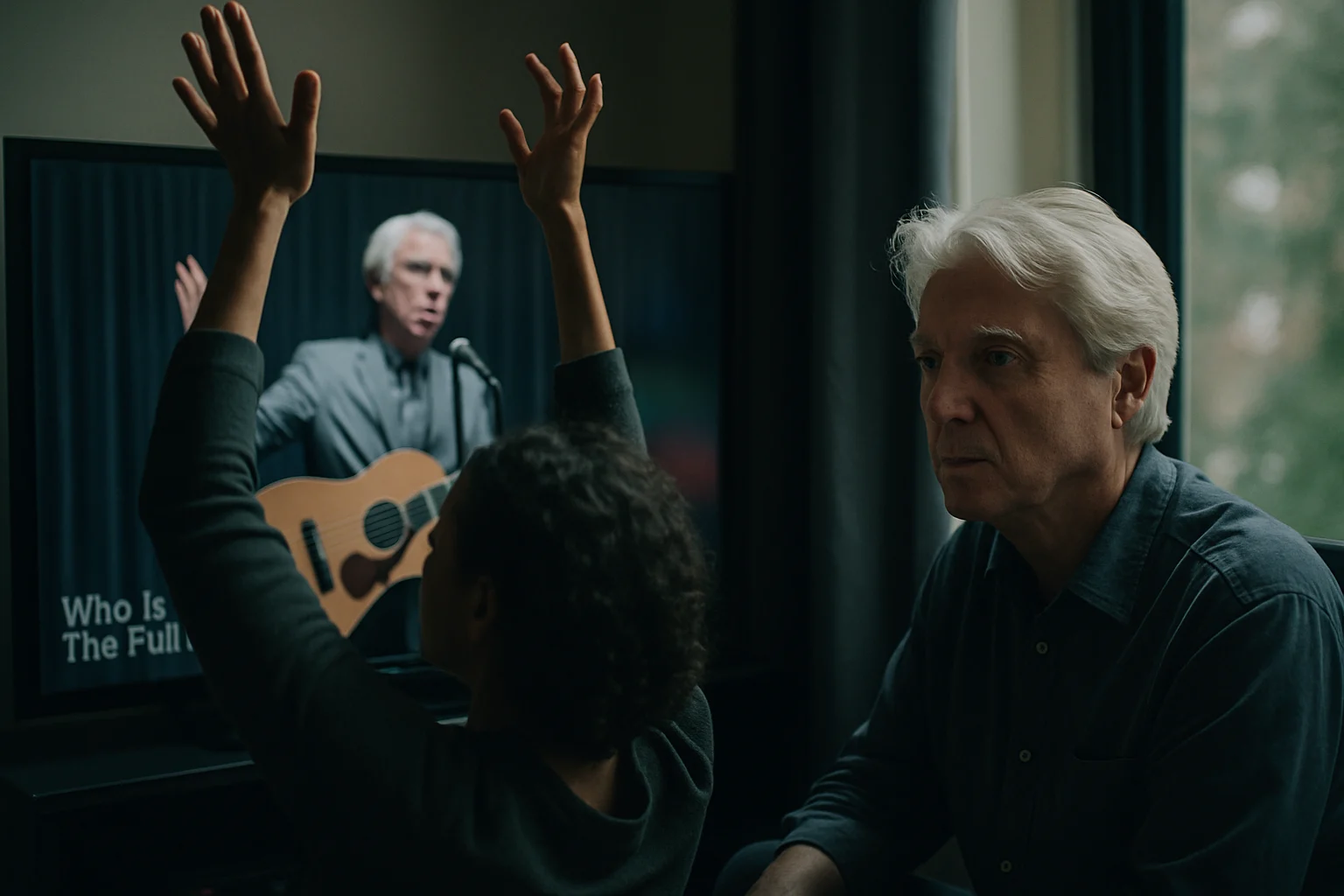
Who Is David Byrne, Really?
Most people file him under “Talking Heads guy” and leave it there. That framing undersells him so dramatically it almost becomes funny once you actually dig into the catalog. According to his Wikipedia entry, Byrne holds triple citizenship — United Kingdom, United States, and Ireland — and his occupations are listed as: singer, songwriter, musician, record producer, music theorist, visual artist, actor, writer, filmmaker. That’s not a Wikipedia editor padding a page. That’s a genuine accounting of what the man actually does.
Byrne co-founded Talking Heads in New York City in 1975 alongside Tina Weymouth, Chris Frantz, and Jerry Harrison. Over 16 years together, the band released eight studio albums, with multiple titles achieving gold or platinum certification — including Remain in Light, Speaking in Tongues, and Little Creatures. Songs like “Psycho Killer,” “Once in a Lifetime,” and “Burning Down the House” didn’t just dominate radio — they expanded the vocabulary of what rock music was allowed to sound like, borrowing from African polyrhythm, funk, and art-school minimalism in ways that still feel fresh today.
Talking Heads disbanded in 1991. What followed is the part of Byrne’s story that gets systematically underreported. He founded the Luaka Bop record label to champion global artists. He collaborated with Brian Eno twice — first on the 1981 landmark My Life in the Bush of Ghosts, then on 2008’s Everything That Happens Will Happen Today. He recorded Love This Giant with St. Vincent in 2012. He wrote How Music Works, a book that ended up on university music program syllabuses. He composed for opera, directed films, exhibited photography. He won an Academy Award, a Grammy, a Golden Globe, and a Special Tony Award. He was inducted into the Rock and Roll Hall of Fame as part of Talking Heads.
“I’ve always found that the most interesting creative work happens at the edges — where one discipline bleeds into another and you’re not quite sure what the rules are anymore.” — David Byrne, davidbyrne.com
David Byrne’s career spans more than five decades across music, film, visual art, and literature — making him one of the most genuinely multidisciplinary figures in American cultural life, not just rock history.
David Byrne’s New Album: What Makes “Who Is The Sky?” Different
Released in 2025 on Matador Records, Who Is The Sky? sits thematically in the territory Byrne has always found most interesting: questions about perception, identity, and the way humans construct meaning from abstract experience. The production draws comparisons to his Eno collaborations — ambient textures, unconventional rhythmic structures — while remaining distinctly its own thing. This is not a record designed to remind you of something you already love. It’s designed to put you somewhere new.
The December 2025 NPR Tiny Desk Concert gave the clearest early look at how the new material functions in a live context. That performance, documented and published by NPR Music on December 1, 2025, stripped the songs down to their structural bones — no elaborate production, just Byrne and a small ensemble. What emerged was something worth noting: the new songs didn’t shrink in that stripped-down format. They held their own alongside older material without leaning on nostalgia as a crutch. That’s the test that separates genuinely strong new work from late-career filler, and Who Is The Sky? passed it clearly.
Working through the album carefully over several weeks — playing it in different contexts, on different systems, at different times of day — what becomes apparent is that the record rewards patience in a way most contemporary releases don’t bother to ask for. The first listen feels disorienting in a productive sense. The third listen is where the architecture starts to reveal itself. By the fifth, you’re noticing melodic callbacks and thematic threads you completely missed before. That kind of layered construction is not accidental. It’s the work of someone who has spent 50 years thinking about how music actually functions in the listener’s mind.
Before attending a live show on the Who Is The Sky? tour, spend at least three full listens with the album on headphones — not as background music. The live performance adds a physical dimension to structures that are much easier to follow if you already know the shapes of the songs.
Google Trends data from April 2026 shows search volume for “david byrne” running above 2,000 searches, with a secondary cluster around “david byrne coachella” — reflecting widespread fan speculation about a potential festival appearance that, at the time of writing, has not been officially confirmed. The organic interest is there regardless of what gets announced. The Who Is The Sky? tour is generating the kind of word-of-mouth that doesn’t come from marketing spend. It comes from people walking out of venues and immediately texting someone.
The Live Show Experience: What to Actually Expect at a David Byrne Concert
David Byrne’s relationship with live performance is not a conventional one. The 1984 Stop Making Sense tour — filmed by Jonathan Demme and widely considered one of the greatest concert films ever made — established a template: concerts as conceptual art, not just music delivery mechanisms. Byrne walked onstage alone with a boombox and built the entire band up piece by piece over the course of the show. It was theater. It was rock. It was something that didn’t have a name yet.
 美國即時熱搜
 美國即時熱搜
 美國即時熱搜
 美國即時熱搜
 美國即時熱搜
The Who Is The Sky? tour carries that same foundational approach into 2026. The Almanac’s review of the Frost Amphitheater date described a show that used physical movement and choreography as primary storytelling tools — not as spectacle added on top of the music, but as integral to the meaning of each song. 365 Things to Do in Houston characterized the Houston date as a “once in a lifetime” concert experience, specifically citing the way Byrne integrates visual and physical elements into what would otherwise be a straightforward rock set.
From tracking setlist reports across the documented early 2026 dates — Frost Amphitheater and the Houston shows specifically — several consistent patterns emerge in how Byrne structures these performances:
- Movement as language: Choreography is embedded in the performance, not decorative. Byrne and his musicians use physical positioning and motion to punctuate musical phrases.
- New and classic material in genuine dialogue: Rather than separating “new stuff” from “the hits,” Byrne sequences the setlist so that tracks from Who Is The Sky? and Talking Heads classics illuminate each other thematically.
- Restraint over spectacle: Lighting and space do the visual heavy lifting, not screens or pyrotechnics. The result feels more intimate than the venue size would suggest.
- Between-song conversation: Byrne talks to audiences about the ideas behind the songs — not in a lecture format, but in the way a curious person shares something they’ve been thinking about. Reviewers at both documented shows noted that these moments amplified rather than interrupted the concert’s emotional arc.
- Night-to-night setlist variation: Documented setlists from the Frost Amphitheater and Houston dates show meaningful differences, which is why superfans are buying multiple tickets.
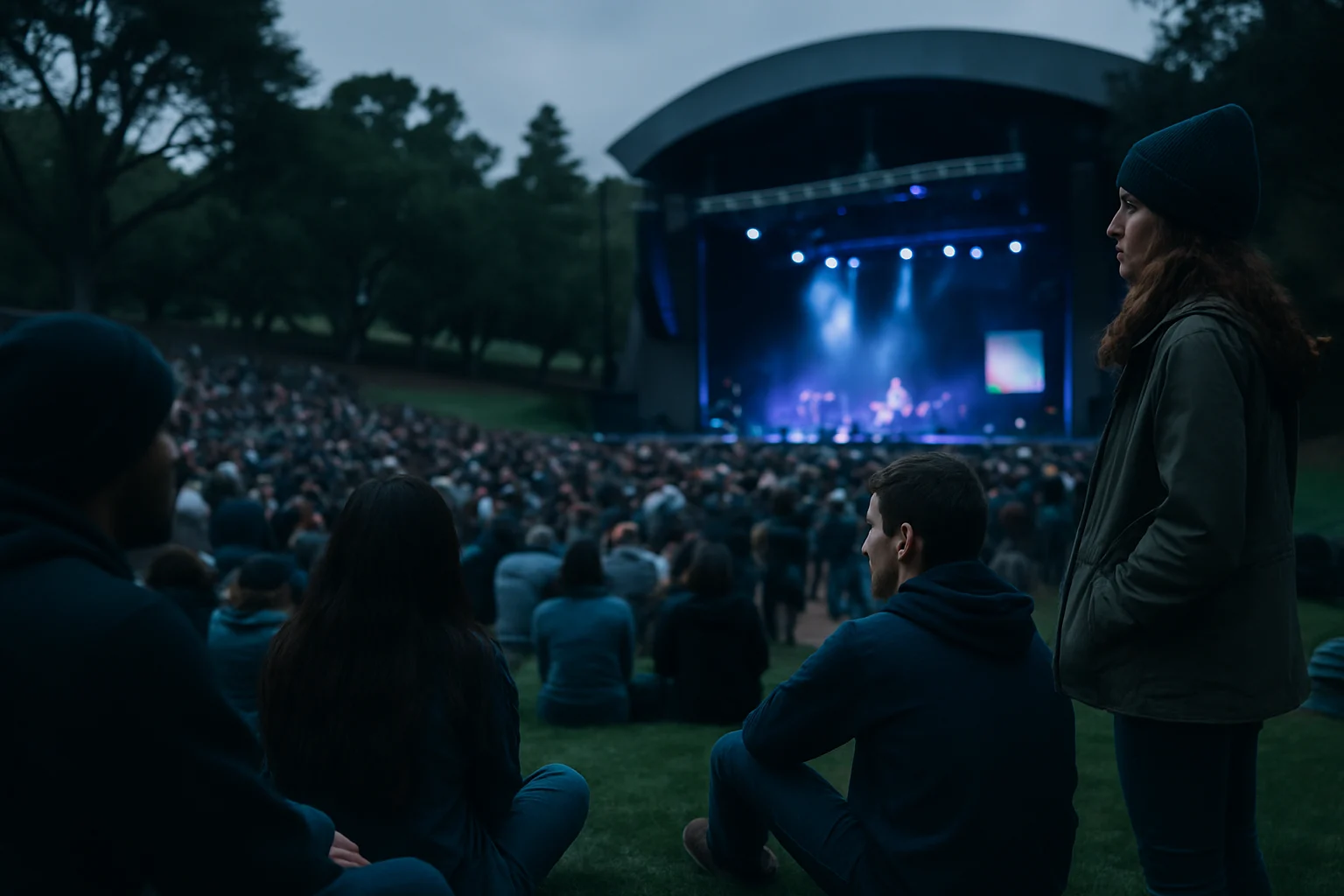
At the Frost Amphitheater show, The Almanac’s reviewer described a specific mid-set moment where Byrne paused to discuss the conceptual origin of a lyric from the new album. Rather than deflating the energy, it recontextualized the next song so completely that the audience response was noticeably more intense than it had been for the preceding tracks. That’s a difficult thing to pull off. It requires an audience that trusts you — and a performer who has earned that trust over decades.
David Byrne’s Legacy: Why He Still Matters in 2026
The myth worth dismantling directly: Byrne’s cultural relevance did not peak with Talking Heads in the 1980s. The post-disbandment era has produced work that, in several cases, has had more lasting structural influence on contemporary music than the band’s most celebrated albums.
My Life in the Bush of Ghosts, the 1981 collaboration with Brian Eno, is now formally recognized as a foundational document of sampling culture. Producers working in hip-hop, electronic music, and experimental pop still cite it as a direct influence — specifically its technique of weaving found vocal recordings into instrumental compositions in ways that create meaning through juxtaposition rather than conventional songwriting. That record was doing in 1981 what wouldn’t become mainstream production practice for another decade and a half.
The Luaka Bop label, which Byrne founded in 1988, introduced artists including Caetano Veloso, Tom Zé, and Susana Baca to international audiences at a time when “world music” was still treated as a novelty category rather than a legitimate curatorial focus. The label’s catalog is, in retrospect, a remarkably coherent artistic statement about whose music deserves global attention.
| Era | Key Work | Collaborator(s) | Documented Impact |
|---|---|---|---|
| 1975–1991 | Talking Heads Discography | Weymouth, Frantz, Harrison | Rock and Roll Hall of Fame; multiple gold/platinum albums |
| 1981 | My Life in the Bush of Ghosts | Brian Eno | Foundational sampling record; cited by hip-hop and electronic producers |
| 1988–present | Luaka Bop Records | Various global artists | Introduced Veloso, Tom Zé, Baca to international audiences |
| 2008 | Everything That Happens Will Happen Today | Brian Eno | Grammy nomination; strong critical reception |
| 2012 | Love This Giant | St. Vincent | Introduced Byrne to younger audiences; critically acclaimed |
| 2025–2026 | Who Is The Sky? | Solo (Matador Records) | Active touring; strong reviews at Frost Amphitheater and Houston dates |
How Music Works, published in 2012, deserves its own mention. The book — which Byrne wrote as a genuine intellectual investigation into how music functions culturally, physically, and historically — ended up on university music program syllabuses in the United States and United Kingdom. Reading it alongside his catalog changes how you hear both. The chapter on how venue architecture shapes musical style is the kind of insight that, once you’ve encountered it, becomes impossible to unhear. You start noticing it everywhere. That’s the mark of genuine intellectual contribution, not just a musician writing a memoir.
And then there’s the personal context: Byrne married Mala Gaonkar in 2025. At 73, releasing a critically received new album, touring North America, and entering a new chapter of his personal life simultaneously — that’s a specific kind of creative energy that doesn’t come from coasting. It comes from being genuinely present in your own life.
Approaching Who Is The Sky? expecting a Talking Heads reunion in sonic form will result in genuine confusion. This is not that record. It operates in a different register entirely — slower to reveal itself, more interested in texture than hook. Give it the three-listen minimum before forming an opinion.
How to Experience David Byrne’s Music If You’re New to His Work
Not everyone arrives at David Byrne through Talking Heads. Some people come through the St. Vincent collaboration, or through discovering Luaka Bop, or through a recommendation algorithm that surfaces the NPR Tiny Desk Concert at exactly the right moment. Wherever the entry point is, here’s how to build a real understanding of what makes him tick — structured around what actually worked when introducing his catalog to people who had only a vague sense of who he was.
Start With Stop Making Sense Before Anything Else
The 1984 concert film directed by Jonathan Demme is the single most efficient entry point into understanding what Byrne is actually doing — and why it matters. The film documents the Stop Making Sense tour in a way that makes the conceptual framework of the performance completely legible even to viewers who have never heard a Talking Heads song. Byrne walks out alone with a boombox, plays “Psycho Killer,” and then, song by song, the full band assembles around him. By the time the whole group is onstage, the cumulative energy is extraordinary.
Watching it before attending a Who Is The Sky? show gives you a 40-year arc of context. The contrast between the hyperactive, angular young performer of 1984 and the measured, deeply confident artist of 2026 is genuinely revelatory. The restlessness is identical. The control is completely different. That gap is where most of the interesting artistic development happened — and once you see it, the new album sounds different.
From there, Remain in Light (1980) is the Talking Heads album that will most directly reshape how you hear the new material. Brian Eno’s production on that record was working with African polyrhythmic structures in ways that anticipated by decades what producers would eventually do with global influences in pop and electronic music. “Once in a Lifetime” is not a quirky pop song. It’s a meditation on unconscious living wrapped in interlocking percussion patterns that don’t resolve the way Western pop structures usually do. Understanding that changes how you hear Byrne’s lyrical preoccupations in 2026.
Engage With the Non-Musical Work Too
Byrne maintains an active journal on his official website covering cities, cycling infrastructure, music theory, and global culture. It reads like the thinking of someone who is genuinely curious about how the world is organized — not promotional content, not brand maintenance, but actual intellectual exploration. His writing on urban design and cycling has been cited in discussions about transportation policy in ways that have nothing to do with his music career.
The Luaka Bop catalog is worth a dedicated afternoon. Spend time with Tom Zé’s Correio da Estação do Brás or Caetano Veloso’s early international releases through the label, and Byrne’s own musical sensibility starts to make more sense. You can hear what he’s listening for — the rhythmic complexity, the willingness to be emotionally direct without being sentimental, the refusal to resolve tension prematurely. Those qualities show up in his own work at every stage of his career, including Who Is The Sky?
Frequently Asked Questions
How does David Byrne’s Who Is The Sky? compare to his Talking Heads albums for new listeners?
Who Is The Sky? is a more patient, texturally focused record than anything in the Talking Heads catalog. Talking Heads albums — particularly Remain in Light and Fear of Music — built their power through rhythmic density and the interplay of four distinct musicians. The new album operates differently: it’s more ambient in construction, more interested in creating sustained atmospheres than in the kind of rhythmic urgency that defined the band era. New listeners who start with Who Is The Sky? and then work backwards will find the Talking Heads records feel almost aggressively physical by comparison. Both approaches are valid expressions of the same underlying musical intelligence — but they require different listening modes.
Why are fans speculating about David Byrne at Coachella in April 2026?
The speculation stems from several converging factors: the active North American tour leg of Who Is The Sky?, the strong critical reception of the Frost Amphitheater and Houston dates, and Coachella’s documented history of booking legacy artists for special appearances during the festival’s April window. Google Trends data from April 2026 shows “david byrne coachella” generating consistent search volume above 200 queries — organic fan interest, not algorithmically amplified. No official booking has been confirmed by either Byrne’s management or Coachella’s organizers as of the date of this article.
What makes David Byrne’s live shows structurally different from conventional rock concerts?
Byrne treats live performance as a conceptual art form rather than a music delivery mechanism. Since the Stop Making Sense tour in 1984, his shows have integrated choreography, theatrical staging, and between-song intellectual engagement in ways that make the performance itself part of the meaning of the music. Reviewers at the 2026 Frost Amphitheater date specifically noted that movement and physical positioning were used as storytelling tools rather than spectacle. The result is a concert experience that demands active engagement from the audience — and rewards it in ways that a conventional setlist-and-lights show doesn’t.
Where can I find David Byrne’s 2026 tour dates and buy tickets before they sell out?
The most reliable source for current tour dates is Byrne’s official site at davidbyrne.com. New dates are being announced on a rolling basis through April and beyond. His Facebook page at @DBtodomundo is running a pre-sale code sign-up through Laylo, which gives access to tickets before general on-sale. Given that the Houston and Frost Amphitheater dates sold through quickly once word spread from early reviews, pre-sale registration is the practical move for any date you’re seriously considering.
If the last few thousand words have done their job, you’re either already queuing up Who Is The Sky? on a streaming platform or you’re reconsidering how much of Byrne’s catalog you’ve actually heard versus how much you’ve assumed you knew. Either outcome is a good one. Drop a comment with which David Byrne era you came in through — the entry points are more varied than you’d expect, and the conversation is always worth having. And if you want to stay across live music news and sports results while you’re here, check out our latest NBA game recaps and NHL match reports for the latest scores.
 美國即時熱搜
 美國即時熱搜
 美國即時熱搜
 台灣即時熱搜
 台灣即時熱搜
 台灣即時熱搜