The Shocking Truth About John Wooden’s Rise from Farm Boy to Basketball Legend
Most people think legendary coaches are born with natural talent, but John Wooden’s story completely shatters that myth. The man who would become known as the “Wizard of Westwood” started life milking cows at dawn on a modest Indiana farm with no electricity. Yet this humble beginning forged the character that would later revolutionise basketball coaching forever.
What’s truly mind-blowing? Wooden won 10 NCAA championships in just 12 years — a feat so extraordinary that no coach has come close to matching it. But here’s what they don’t tell you: his greatest achievement wasn’t the trophies. It was creating a philosophy that transformed not just basketball, but how we think about success itself.

Born on 14th October 1910 in Hall, Indiana, John Robert Wooden grew up in a world vastly different from today’s high-tech basketball environment. His father, Joshua Hugh Wooden, handed him a piece of paper with seven life principles that would later become the foundation of his legendary Pyramid of Success.
Wooden’s father gave him life principles on a piece of paper that became the blueprint for the most successful coaching philosophy in sports history.
The transformation from farm chores to basketball greatness began in a barn. Wooden and his three brothers — Maurice, Daniel, and William — played with a homemade basketball and a tomato basket as their hoop. This makeshift court became the unlikely birthplace of basketball genius.
The Purdue Years: Building the Foundation
When Wooden arrived at Purdue University in 1928, few could have predicted the impact this quiet guard would have on basketball history. Playing from 1928 to 1932, he earned three consecutive All-America selections and was named college basketball player of the year.
But here’s the fascinating part: Wooden was selected as team captain during his junior year — a rare honour that revealed his natural leadership abilities. He graduated with an English degree, a detail that would prove crucial to his later success as a teacher-coach who could communicate complex ideas with remarkable clarity.
| Achievement | Year | Significance |
|---|---|---|
| All-America Selection | 1930-1932 | Three consecutive years |
| College Player of the Year | 1932 | National recognition |
| Team Captain | 1931 | Leadership recognition |
| Helms National Championship | 1932 | Team success |
John Wooden’s Revolutionary Coaching Philosophy: The Pyramid That Changed Everything
Here’s where most coaching analysis gets it completely wrong. Everyone focuses on Wooden’s wins, but the real revolution was his approach to defining success itself. While other coaches chased victories, Wooden redefined what winning actually meant.
His famous definition still gives me chills: “Success is peace of mind, which is a direct result of self-satisfaction in knowing you made the effort to do your best to become the best that you are capable of becoming.”
“Success is peace of mind, which is a direct result of self-satisfaction in knowing you made the effort to do your best to become the best that you are capable of becoming.” — John Wooden
The Pyramid of Success wasn’t just motivational fluff — it was a systematic approach to human development that Wooden spent 14 years perfecting. The pyramid consists of 15 building blocks, with five foundational stones that support everything else.
The Foundation Stones That Built Champions
The bottom tier reveals Wooden’s genius: Industriousness, Friendship, Loyalty, Cooperation, and Enthusiasm. Notice what’s missing? Talent. Skill. Natural ability. Wooden understood something profound: character traits could be developed, while talent alone was unreliable. (Related: )
- Industriousness — “There is no substitute for work. Worthwhile results come from hard work and careful planning.”
- Friendship — “Comes from mutual esteem, respect and devotion. Like marriage, it must not be taken for granted but requires a joint effort.”
- Loyalty — “To yourself and to all those dependent upon you. Keep your self-respect.”
- Cooperation — “With all levels of your co-workers. Listen if you want to be heard. Be interested in finding the best way, not in having your own way.”
- Enthusiasm — “Brushes off upon those with whom you come in contact. You must truly enjoy what you are doing.”
Wooden never talked about winning in team meetings. Instead, he focused on preparation, effort, and continuous improvement — the wins followed naturally.

The UCLA Dynasty: How John Wooden Built the Greatest Basketball Program Ever
When Wooden arrived at UCLA in 1948, the basketball program was mediocre at best. The team played in a cramped gymnasium, and basketball was clearly secondary to football. What happened next defies belief.
From 1964 to 1975, UCLA won 10 NCAA championships in 12 years, including an unprecedented seven consecutive titles from 1967 to 1973. But here’s the statistic that truly showcases Wooden’s dominance: during one stretch, UCLA won 88 consecutive games.
 美國即時熱搜
 美國即時熱搜
 美國即時熱搜
 美國即時熱搜
 美國即時熱搜
In 1971, UCLA’s winning streak reached 88 games — a record that stood for decades and demonstrated the consistency of Wooden’s system.
The Secret Behind the Championships
Most people assume Wooden’s success came from recruiting the best players. Wrong. His genius lay in developing systems that made good players great and great players legendary. Take Kareem Abdul-Jabbar (then Lew Alcindor) — undoubtedly talented, but it was Wooden’s teaching that transformed raw ability into unstoppable dominance.
Wooden’s practice sessions were legendary for their precision. He planned every minute, sometimes scripting practices down to the second. Players knew exactly what they’d be doing at 3:47 PM on a Tuesday. This wasn’t micromanagement — it was masterful preparation that eliminated wasted time and maximised improvement.
| Championship Years | Key Players | Notable Achievement |
|---|---|---|
| 1964, 1965 | Gail Goodrich, Keith Erickson | First back-to-back titles |
| 1967-1973 | Lew Alcindor, Bill Walton | Seven consecutive championships |
| 1975 | Richard Washington, David Meyers | Final championship |
John Wooden’s Timeless Wisdom: Quotes That Still Transform Lives Today
Here’s what separates Wooden from other coaches: his words carry weight decades after his retirement. These aren’t just catchy slogans — they’re distilled wisdom from a man who understood human nature at its deepest level.
“Be more concerned with your character than your reputation, because your character is what you really are, while your reputation is merely what others think you are.” This quote perfectly encapsulates Wooden’s philosophy of internal versus external validation.
The Most Powerful Wooden Quotes and Their Hidden Meanings
- “Don’t mistake activity for achievement.” — In our busy world, this reminds us that being busy doesn’t equal being productive.
- “A coach is someone who can give correction without causing resentment.” — The art of leadership distilled into one sentence.
- “You can’t let praise or criticism get to you. It’s a weakness to get caught up in either one.” — Emotional equilibrium as a superpower.
- “Things turn out best for the people who make the best of the way things turn out.” — Resilience and adaptability in action.
Don’t just read these quotes — apply them. Wooden’s wisdom only works when put into practice consistently.
What makes these quotes extraordinary is their practical application. Wooden lived every principle he taught, which gave his words authentic power. Players could see the philosophy in action, not just hear it preached.
The Teaching Method Behind the Wisdom
Wooden didn’t just share quotes — he demonstrated them. When teaching basketball fundamentals, he’d start with the basics: how to put on socks and shoes properly. Players initially thought this was ridiculous, but they soon understood. If you can’t master the fundamentals, you’ll never excel at the complex skills. (Related: “Tornado Warning EXPOSED!” The Life-Saving Truth They Won’t Tell You)

The Lasting Impact of John Wooden on Modern Basketball and Beyond
Walk into any serious basketball program today, and you’ll find Wooden’s fingerprints everywhere. His influence extends far beyond the court, shaping how we think about leadership, education, and personal development across all fields.
Current NBA coaches regularly reference Wooden’s principles. Phil Jackson, who won 11 NBA championships, frequently cited Wooden as a major influence. Steve Kerr, coach of the Golden State Warriors, has spoken about applying Wooden’s teaching methods to professional players.
The Modern Applications of Wooden’s Methods
Corporate leaders study Wooden’s Pyramid of Success for business applications. The principles of industriousness, cooperation, and enthusiasm translate perfectly to team management and organisational culture. Fortune 500 companies regularly use Wooden’s philosophy in leadership training programs.
In education, teachers apply Wooden’s approach to character development alongside academic achievement. The focus on effort over outcome has revolutionised how educators approach student motivation and assessment.
Microsoft’s leadership development program incorporates Wooden’s Pyramid of Success, showing how his principles apply beyond sports to technology innovation.
The Statistical Legacy
The numbers tell an incredible story. Wooden’s overall college coaching record: 664 wins and 162 losses. His UCLA record: 620-147. But statistics only capture part of his impact.
- 88-game winning streak — A record that stood for decades
- 10 NCAA championships — More than any other coach in history
- 4 perfect seasons — Undefeated campaigns that showcased systematic excellence
- 38 consecutive tournament wins — Dominance when it mattered most
John Wooden’s Awards and Recognition: A Testament to Excellence
The accolades tell the story of a man who excelled at every level. Wooden was inducted into the Basketball Hall of Fame twice — once as a player (1960) and once as a coach (1973). This dual recognition is almost unheard of in sports.
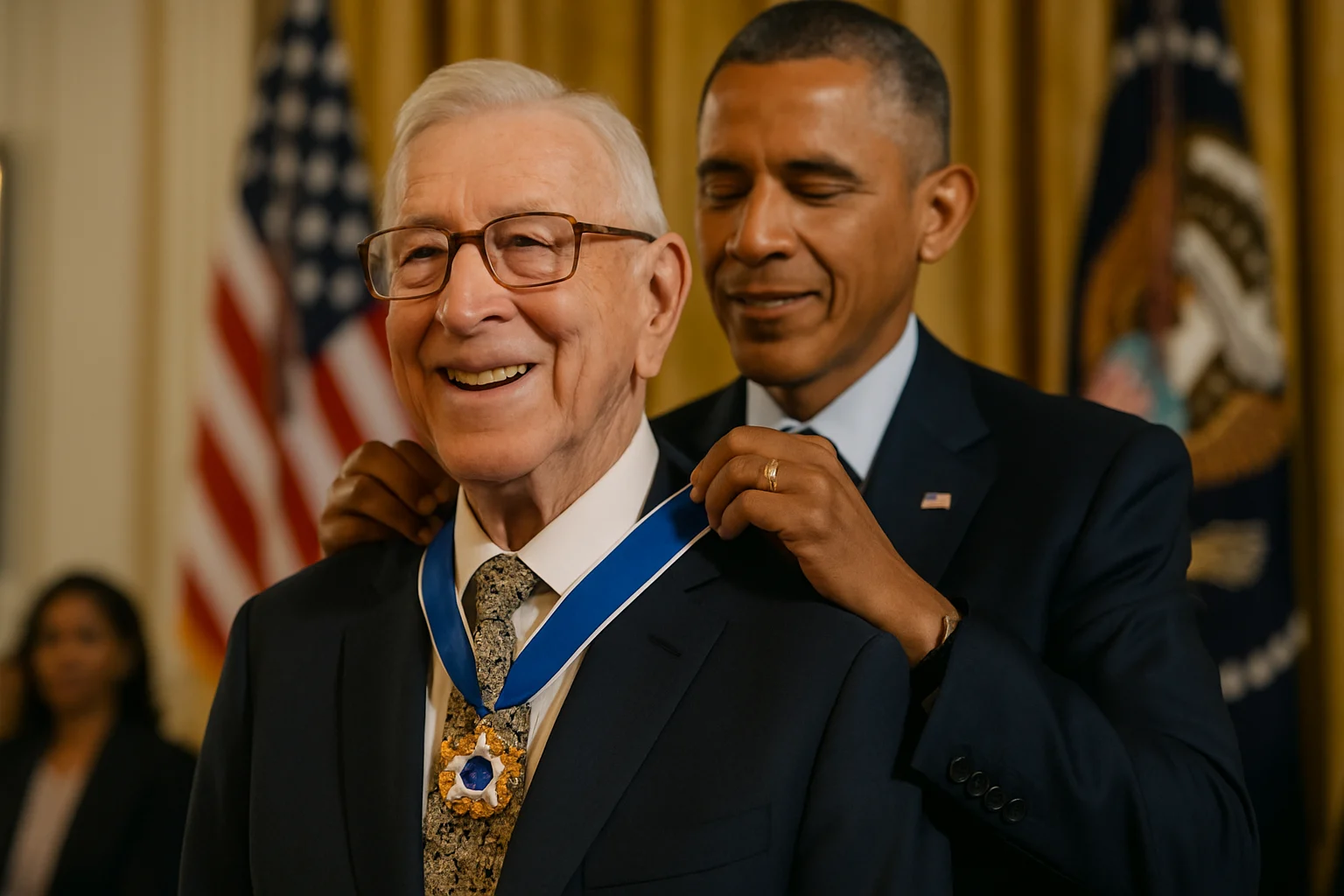
In 2003, President George W. Bush awarded Wooden the Presidential Medal of Freedom, the highest civilian honour in the United States. The citation read: “John Wooden has inspired countless young people through his career as a teacher, coach, and author.”
The Complete Honours List
As a coach, Wooden received virtually every major award available:
| Award | Years Received | Significance |
|---|---|---|
| AP College Coach of the Year | 1967, 1969, 1970, 1972, 1973 | Five-time recipient |
| Henry Iba Award | 1964, 1967, 1969-1973 | Seven-time winner |
| Sports Illustrated Sportsman of the Year | 1972 | National recognition |
| Presidential Medal of Freedom | 2003 | Highest civilian honour |
What’s remarkable about these awards is their consistency over time. Wooden didn’t have one great season — he sustained excellence for over a decade. This consistency reflects the systematic approach that made his methods so effective.
Beyond Basketball Recognition
Wooden’s influence extended far beyond sports. He received the Theodore Roosevelt Award in 1996, recognising his contributions to society through athletics. The award honours individuals who embody the ideals Roosevelt championed: citizenship, scholarship, and athletic achievement.
The Books and Teachings That Preserve Wooden’s Legacy
Wooden understood that his greatest impact would come through sharing his philosophy beyond the basketball court. His books aren’t just sports memoirs — they’re practical guides for living a meaningful life.
“Wooden: A Lifetime of Observations and Reflections On and Off the Court” remains his most comprehensive work. Published in 1997, it combines autobiography with philosophical insights, giving readers both the story and the lessons learned.
Essential Reading from the Master Teacher
Each of Wooden’s books serves a specific purpose:
- “They Call Me Coach” — His coaching philosophy and methods explained in detail
- “Wooden on Leadership” — Principles for leading teams and organisations effectively
- “The Wisdom of Wooden” — Distilled quotes and insights for daily application
- “A Game Plan for Life” — How to apply basketball lessons to personal development
Start with “They Call Me Coach” to understand Wooden’s foundational principles, then move to “Wooden on Leadership” for practical applications.
What makes these books special is their accessibility. Wooden wrote in plain English, avoiding academic jargon while delivering profound insights. His writing style mirrors his coaching approach — clear, direct, and focused on practical application.
The Teaching Philosophy Behind the Writing
Wooden’s books reflect his core belief that teaching and learning never stop. Even in retirement, he continued refining his ideas, always looking for better ways to communicate timeless principles to new generations.
The books also reveal Wooden’s humility. Despite his unprecedented success, he consistently credits others — his father, his wife Nell, his players, and his assistant coaches. This humility made his teachings more powerful because readers could see he practiced what he preached.
Frequently Asked Questions About John Wooden
What made John Wooden such a successful basketball coach?
John Wooden’s success stemmed from his systematic approach to character development and his focus on fundamentals. Rather than just teaching basketball skills, he developed the whole person through his Pyramid of Success philosophy. His emphasis on preparation, consistency, and continuous improvement created a culture where excellence became the standard, not the exception.
What is John Wooden’s Pyramid of Success?
The Pyramid of Success is Wooden’s 15-block framework for achieving personal and professional excellence. Built on five foundation stones — Industriousness, Friendship, Loyalty, Cooperation, and Enthusiasm — it provides a systematic approach to character development. The pyramid took Wooden 14 years to complete and represents his life’s philosophy distilled into practical principles.
How many NCAA championships did John Wooden win at UCLA?
John Wooden won 10 NCAA championships during his tenure at UCLA from 1948 to 1975. This includes an unprecedented seven consecutive titles from 1967 to 1973. His teams also achieved an 88-game winning streak and four perfect seasons, establishing UCLA as the most dominant program in college basketball history.
What are John Wooden’s most famous quotes?
Some of Wooden’s most influential quotes include: “Success is peace of mind in knowing you made the effort to become the best you’re capable of becoming,” “Be more concerned with your character than your reputation,” and “Don’t mistake activity for achievement.” These quotes reflect his philosophy of focusing on effort and character rather than external validation or busy work.
John Wooden’s legacy continues to inspire coaches, leaders, and individuals worldwide. His transformation from an Indiana farm boy to the “Wizard of Westwood” proves that greatness comes not from natural talent alone, but from the systematic development of character, preparation, and unwavering commitment to excellence. Whether you’re coaching a team, leading an organisation, or simply trying to become the best version of yourself, Wooden’s timeless principles provide a roadmap for meaningful success.
 美國即時熱搜
 美國即時熱搜
 美國即時熱搜
 台灣即時熱搜
 中國即時熱搜
 台灣即時熱搜
 台灣即時熱搜
 台灣即時熱搜
